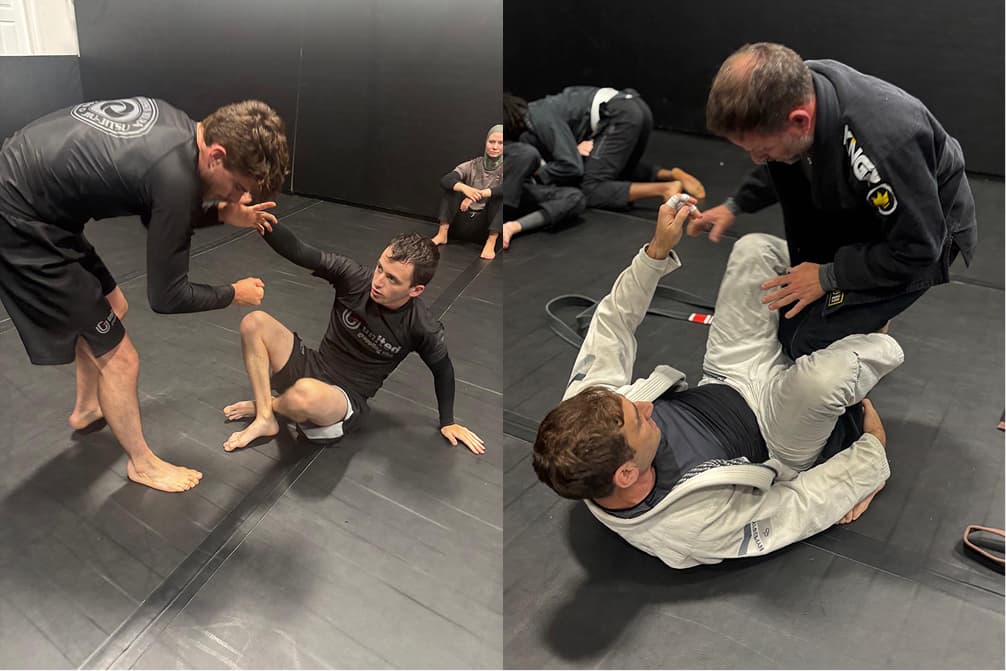
Brazilian Jiu-Jitsu comes in two main styles: gi and no-gi. While the core principles are the same, each offers unique benefits and challenges that shape your overall game.
Gi Training Builds Control and Precision
Gi training focuses on control and precision. The use of grips slows things down, helping you develop strong fundamentals, positional awareness, and a wider range of submissions like collar chokes.
The tradeoff is that it can become grip-heavy, and some positions feel very different once those handles disappear.
No-Gi Training Develops Speed and Adaptability
No-gi training is faster and more dynamic. Without grips, you rely on timing, movement, and body control. That builds athleticism and adaptability in ways that are hard to fake.
The downside is that it can feel chaotic and harder to control, especially for beginners who are still learning how to manage scrambles and transitions.
Why Training Both Matters
The key takeaway is simple: training both makes you better.
Gi sharpens technique and patience, while no-gi improves speed and fluidity. Together, they create a more complete grappler with a broader understanding of control, pressure, movement, and timing.
The Gym Matters Too
Just as important as training both styles is finding a gym that teaches both well.
A club like United Grappling stands out because it offers strong gi and no-gi programs alongside a wrestling program. Wrestling adds another layer through takedowns, pressure, and control, and those skills carry directly into both styles of Jiu-Jitsu.
The Best Path Forward
In the end, the best path forward is not choosing one style and ignoring the rest. It is combining all three.
Train gi. Train no-gi. Add wrestling.
That is how you build a truly well-rounded game.