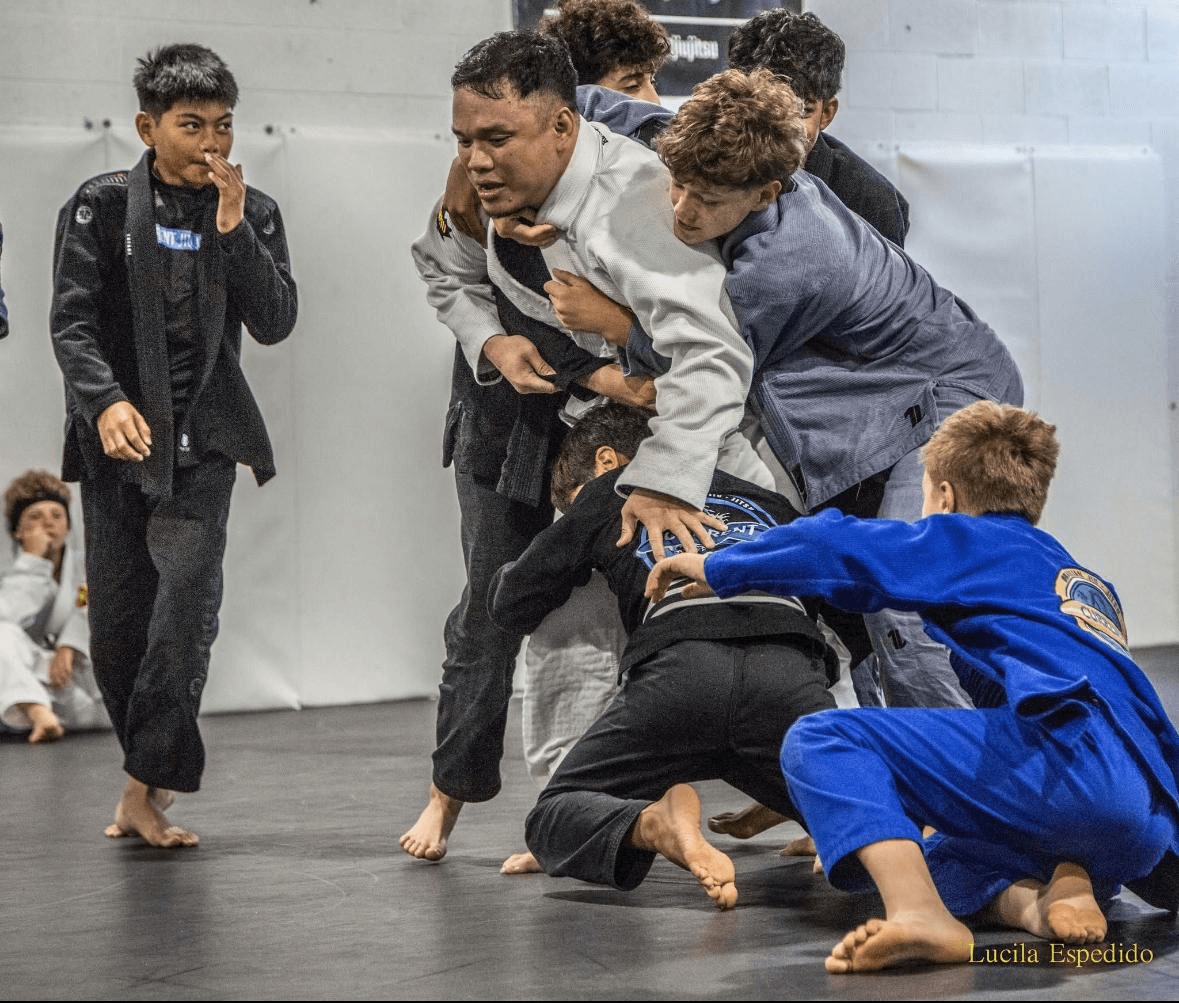
If you're a parent researching Brazilian Jiu-Jitsu for kids, teen wrestling programs, or the long-term benefits of youth martial arts training, this guide will help you make an informed decision.
While self-defense is often the first reason families explore grappling sports, the real benefits go far beyond that.
Building Real Confidence (Not Social Media Confidence)
Confidence today is often measured in likes and followers. But real confidence comes from overcoming challenges.
Both Brazilian Jiu-Jitsu (BJJ) and Wrestling place kids in controlled, safe environments where they must solve problems under pressure.
On the mat, they learn how to:
- Stay calm in difficult situations
- Escape tough positions
- Push through physical fatigue
- Win and lose with maturity
When a 12- or 15-year-old successfully handles a challenging round of training, that confidence carries into school, friendships, and everyday life.
You Don't Have to Start at Age Five
Many sports today require early specialization. Gymnastics, figure skating, and elite soccer programs often demand year-round commitment from a very young age.
Grappling sports are different.
A teen can start wrestling in middle school or high school and still:
- Earn a varsity spot
- Compete at a high level
- Develop elite conditioning
- Build strong technical skills
The same applies to Brazilian Jiu-Jitsu. Teenagers begin as white belts every day and go on to earn belts, compete in tournaments, and even pursue high-level competition.
With wrestling and BJJ, it's not "too late." It's simply the start of the journey.
Individual Growth — No Bench, No Politics
Unlike traditional team sports, grappling is personal. When you step onto the mat, it's just you.
There's no hiding on the bench. No waiting for playing time. No politics about who gets minutes.
That environment teaches:
- Personal responsibility
- Consistency
- Discipline
- Goal setting
- Respect for coaches and teammates
Most BJJ academies do not have tryouts. Wrestling programs typically allow anyone willing to work hard to join. If you show up and put in the effort, you train.
One of the biggest advantages of youth BJJ and wrestling is that athletes develop at their own pace. Some progress quickly. Others take longer. But consistent effort always leads to improvement.
Many teens who didn't thrive in traditional team sports — such as football, basketball, or baseball — often find success in individual sports like wrestling and Brazilian Jiu-Jitsu.
Why? Because success isn't based solely on size, speed, or natural explosiveness. It's built on resilience, work ethic, and skill development.
A More Affordable Youth Sport Option
If you're raising a family in Woodbridge, Maple, Richmond Hill, Thornhill, or Toronto, you already know how expensive youth sports can be.
Rep teams, travel tournaments, hotels, uniforms, and team fees can add up quickly.
Brazilian Jiu-Jitsu and wrestling are often more affordable options because:
- Equipment is minimal (gi, belt, singlet, wrestling shoes)
- There are no mandatory travel circuits
- Families choose when and where to compete
- Competition is optional, not required
In many traditional team sports, the organization dictates the competition schedule. In BJJ and wrestling, you control your level of involvement.
That flexibility matters — both financially and practically.
Physical Fitness and Mental Toughness
Youth wrestling and Brazilian Jiu-Jitsu build:
- Functional strength
- Cardiovascular endurance
- Balance and coordination
- Body awareness
Just as importantly, they develop mental toughness. Young athletes learn how to handle pressure, recover from losses, and stay composed in challenging situations.
These are life skills that extend far beyond sports.
The Bottom Line
Starting Brazilian Jiu-Jitsu or wrestling as a pre-teen or teenager can build:
- Confidence
- Discipline
- Self-defense skills
- Mental resilience
- Long-term physical fitness
There are no typical tryouts. You don't need to specialize at age five. Progress happens at your own speed.
Most importantly, these sports help build strong, capable, and resilient young people — without the overwhelming financial pressure often associated with traditional team sports.
For many families, youth BJJ and wrestling aren't just activities.
They're investments in long-term character development.